How to Budget on Irregular Income: A System for Freelancers and Commission-Based Earners in India
"50-30-20 assumes a fixed paycheque. Freelancers, commission earners and business owners don't get one. Here's how to pay yourself a fixed salary from variable income — and budget it like anyone else."
Admin
Expert Contributor
Every popular budgeting rule you have ever read starts with the same assumption: a fixed number lands in your account on the same date every month. 50-30-20. Pay yourself first. Automate your SIP on the 1st.
All good advice. None of it survives contact with a month where you earned ₹40,000 followed by a month where you earned ₹1,60,000.
If you freelance, run a business, work on commission, or do any kind of project-based or gig work, this describes you. India has tens of millions of people in this position — and almost every budgeting article on the internet quietly assumes you are not one of them.
Here is a system built for income that moves.
The real problem is not the low months
Most people with variable income assume the fix is "save more in the good months." That is correct but incomplete, and incomplete advice is why it keeps failing.
The actual problem is that your spending rises with your income, but your spending does not know how to fall back down. A ₹1,60,000 month quietly resets what feels normal. Rent stays the same, but the dinners, the shopping, the "I earned this" purchases all recalibrate upward. Three months later a ₹55,000 month arrives and every one of those recalibrated habits is still running.
Fixed-income budgeting fails for you not because you cannot plan — it fails because it tries to plan the wrong variable. It plans spending against income. What you need is a system that plans spending against a number that does not move every month.
Step 1: Pay yourself a salary — from yourself, to yourself
This is the single most important shift, and everything else in this article supports it.
Open two accounts. One is your business or income account — every payment, every invoice, every commission lands here and nowhere else. The other is your personal account — the one you actually spend from, the one linked to UPI, the one your family sees.
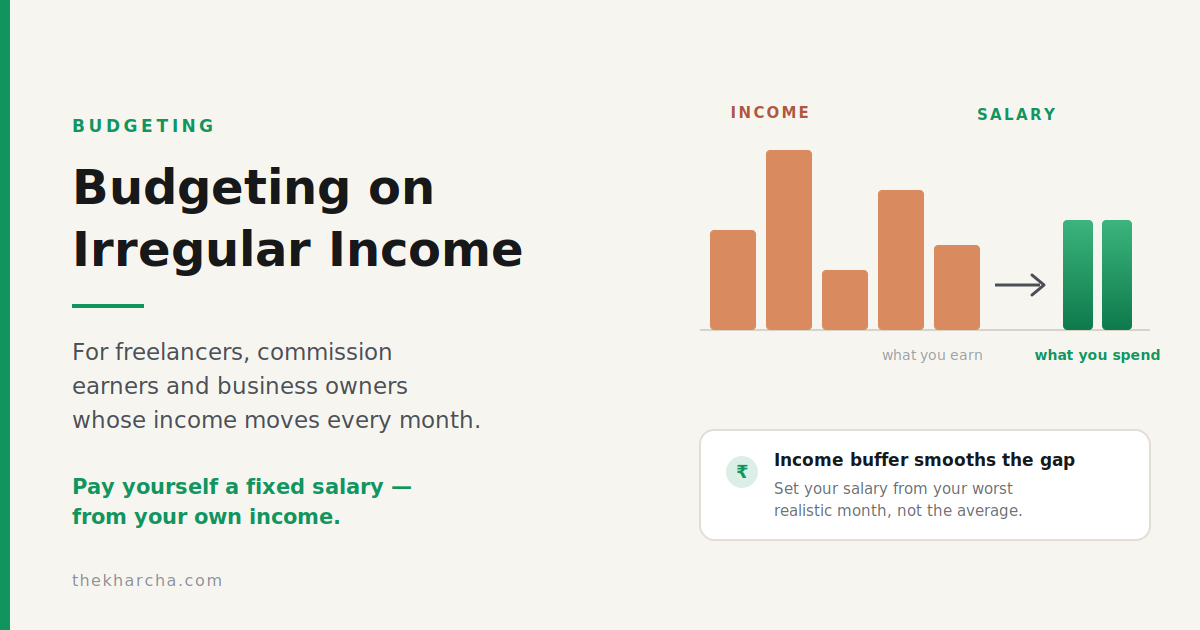
Once a month, on a fixed date, transfer a fixed amount from the income account to the personal account. That transfer is your salary. You decide the number. Your clients and your commission cheques do not.
This one habit converts variable income into fixed income at the only point that matters — the point where you actually spend it. Everything downstream (envelopes, SIPs, EMIs) can now run exactly like it would for someone on a fixed salary, because from your personal account's point of view, it is one.
Step 2: Set your salary from your worst realistic month, not your average
This is where people sabotage the system before it starts. They average their last six months and pay themselves the average. Averages include the good months, and good months are exactly what you are trying to stop depending on.
Instead, look at your worst month from the last 12–18 months — the slow season, the client who paid late, the month between projects. Not the worst month that could theoretically happen, the worst one that actually did. Set your salary at or slightly below that number.
This feels overly conservative in a good month and exactly right in a bad one. That asymmetry is the entire point. A budget that only works when things go well is not a budget, it is a forecast.
Step 3: Build an income buffer before you build anything else
A regular emergency fund answers "what if something breaks." An income buffer answers a different, more frequent question: "what if this month simply does not pay well." For variable income, this buffer matters more than almost anything else you will read about money.
Target three months of your salary (the number from Step 2, not your average income) sitting in the income account, untouched, before any transfer to personal happens. Build it in the good months — when a payment comes in well above what you need for that month's salary, the entire surplus goes to the buffer, not to a bigger transfer.
Once the buffer exists, its job is simple: in a low-earning month, it tops up the salary transfer so your personal account never learns the difference. You are the one smoothing your income — not your landlord, not your credit card.
Step 4: Handle tax and business costs before you ever see the money
If you invoice clients or run a business, taxes and business expenses are not something you pay out of what is "left over" — they are the first claim on every rupee that arrives, before your salary is even calculated.
The moment a payment lands in the income account, split it immediately:
- Tax set-aside — a fixed percentage moved out on arrival, based on your last year's actual effective rate, not a guess. If you are unsure, 25–30% is a safer starting point than anything lower for most freelance and consulting income in India.
- Business costs — software, a co-working desk, equipment, subcontractors, GST if applicable.
- What remains is the only number your salary calculation in Step 1 should ever be based on.
Skip this step and you will eventually face a tax bill that looks exactly like an emergency, except it was never a surprise — it was simply spent before it was set aside.
Step 5: Once you have a salary, budget it exactly like a fixed income
This is the payoff for all the setup above. Your personal account now receives the same number every month. Run your monthly envelopes against it — groceries, eating out, transport, personal, family, buffer — the same way anyone on a fixed salary would.
Your SIPs, insurance premiums, and standing instructions go on the personal account too, timed to your fixed salary date, not to whenever a client happens to pay.
This is the quiet magic of the system: the hardest part of variable-income budgeting — the unpredictability — gets absorbed entirely at the business-account layer, in Steps 1 through 4. By the time money reaches your daily life, it behaves exactly like a paycheque.
What to do the first time you actually run short
Even with a buffer, a genuinely bad stretch will happen — three slow months in a row, a client who disappears, a sector-wide slowdown. When it does, the order of operations matters:
- Draw down the income buffer first. This is exactly what it exists for. Using it is not failure, it is the system working as designed.
- If the buffer runs low, cut the salary transfer — do not skip envelopes selectively. Lower the number you pay yourself and let your existing envelope proportions handle the reduction. This keeps the system intact instead of you making a dozen small unstructured cuts under stress.
- Rebuild the buffer as the priority the moment income recovers — before increasing your salary, before catching up on discretionary spending.
The mindset shift that makes this stick
Fixed-salary earners think in months. Variable-income earners who succeed at this think in runway — how many months could I sustain my current salary if income stopped today. That single number, tracked loosely, tells you more about your actual financial position than your bank balance ever will.
A bank balance of ₹3 lakh means something completely different depending on whether it is sitting on top of a three-month buffer with a stable salary running underneath it, or whether it is the entire buffer, salary, taxes, and business costs all mixed into one number with nothing separated out. Same balance, very different reality.
The system above exists to make sure you always know which situation you are actually in.
TheKharcha lets you run a fixed monthly salary transfer alongside separate buffers and envelopes, so variable income stops meaning variable stress.
Comments
Loading comments…