How Much Rent Can You Actually Afford in India
"The 30% rent rule doesn't quite fit Indian salaries — deductions, deposits, and broker fees change the math. Here's how to work out your real number before you sign a lease."
Admin
Expert Contributor
The broker shows you a flat that is ₹4,000 more than you planned to spend. It is nicer, closer to the metro, and you tell yourself you will "manage" the difference. Six months later you cannot explain where the savings went, and the honest answer is that they went into those ₹4,000, every single month, quietly, before you ever got a chance to save them.
Rent is the one number in most Indian budgets that gets decided once, under time pressure, usually while comparing it to a broker's other listings rather than to your own finances — and then has to be lived with for eleven months no matter what else changes.
Here is how to actually work out the number, instead of guessing and hoping.
The rule everyone quotes, and why it needs adjusting for India
The widely quoted rule from Western personal finance is that rent should not exceed 30% of gross income. Applied directly to Indian salaries, this rule is frequently too loose in expensive cities and unnecessarily tight in smaller ones, for two reasons specific to how Indian pay works.
First, the rule was built around gross income, but Indian salary structures often have a meaningful gap between gross and take-home due to PF, professional tax, and other deductions. Measuring rent against take-home gives a truer picture of what you actually have to work with.
Second, in India, rent rarely arrives alone. Society maintenance, a broker's one-time fee, and often a security deposit of two to ten months' rent — dramatically higher than deposit norms in most other countries — all attach to the housing decision and need to be planned for separately from the monthly figure.
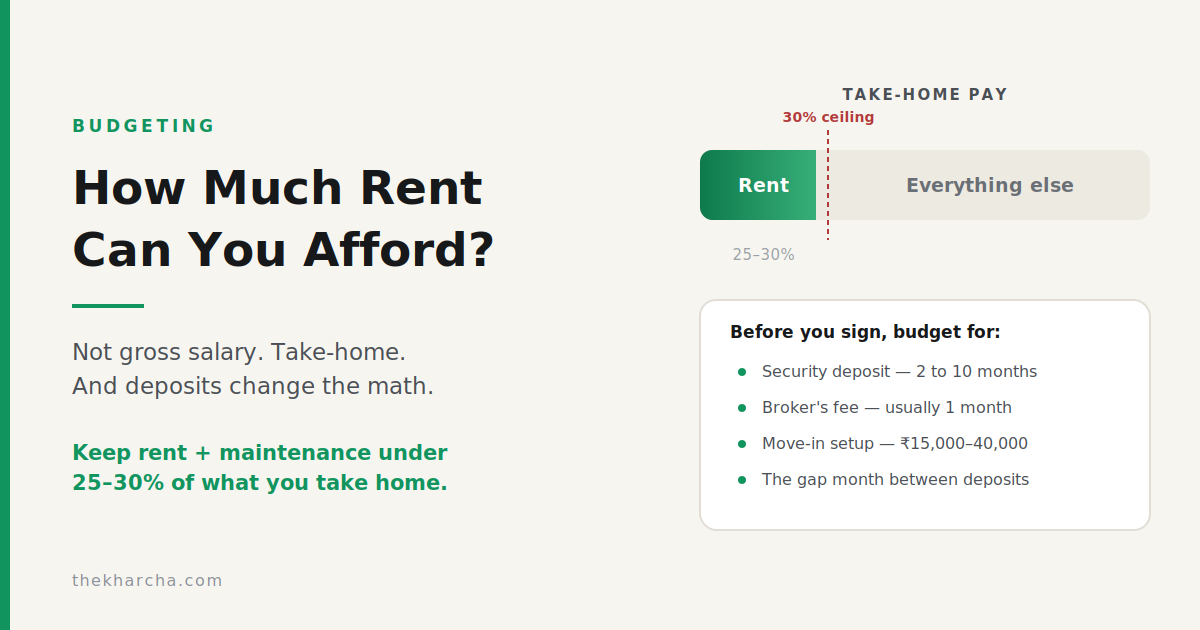
A more useful starting point for India: rent plus maintenance should not exceed 25–30% of take-home pay, with 25% as the comfortable target and 30% as a ceiling you cross only with a clear reason and a clear plan.
Work out your actual number
Take your monthly take-home pay — the amount that actually lands in your account, not your CTC. Multiply by 0.25 for the comfortable target, by 0.30 for the upper limit.
On a ₹60,000 take-home salary, that is ₹15,000 comfortable, ₹18,000 as a ceiling — for rent and maintenance combined, not rent alone. This is where a lot of people miscalculate: a ₹17,000 flat with ₹1,500 maintenance is an ₹18,500 housing cost, already over the ceiling, even though the listing only advertised the smaller number.
Why crossing the ceiling costs more than the extra rent
The direct cost of paying ₹4,000 more in rent is obviously ₹4,000 a month. The actual cost is higher, because rent above your ceiling does not just consume more of your budget — it consumes the part of your budget that would otherwise fund your emergency fund and your investing.
A flat that pushes rent to 40% of take-home does not simply mean "12.5% less for everything else" — for most salary levels it means the difference comes entirely out of savings, because fixed non-negotiable costs like groceries and transport do not compress much. The rent decision, more than almost any other monthly expense, directly determines whether saving happens automatically or requires constant willpower against a budget that was never built to allow it.
Before you sign: the costs beyond monthly rent
Budget for these as a lump sum before house-hunting, not as a surprise during it:
- Security deposit — commonly two to three months in most cities, but can run to ten months in parts of Bangalore and a few other markets. Confirm this number before falling in love with a flat, because it can be a bigger barrier than the monthly rent itself.
- Broker's fee — typically one month's rent, sometimes split between tenant and landlord, sometimes not. Ask before you commit to a viewing, not after.
- Move-in costs — basic furniture, kitchen setup, utility connections. Even a modest first move commonly runs ₹15,000–40,000 depending on how bare the flat is and how much you already own.
- The gap month — most leases want the new place's deposit and first month paid before the old place's deposit is returned. Budgeting as if the old deposit will smoothly fund the new one is a common and avoidable cash-flow mistake.
Add these up separately from your monthly rent ceiling. This is a one-time sinking-fund target, not a monthly budget line — treat it the way you would treat any large predictable expense that does not arrive every month.
When it makes sense to go above the ceiling
The 25–30% guideline is a strong default, not a law. A few situations genuinely justify going higher, deliberately:
- Commute cost and time trade-off. A flat that costs ₹3,000 more but saves ₹2,500 in monthly transport and ninety minutes a day of commute may be a better financial decision overall, not a worse one — run the actual numbers rather than looking at rent in isolation.
- Splitting with a flatmate or partner. The ceiling applies to your share of the cost, not the listing price. A ₹40,000 flat split two ways is a ₹20,000 housing cost per person — calculate against what you actually pay.
- A genuinely temporary phase with a defined end date — a short posting, a known upcoming raise already confirmed in writing. Going over the ceiling with a clear, dated reason to return under it is different from drifting over it with no plan to come back down.
What does not justify it: "I'll manage," said with no specific plan for which other budget category absorbs the difference. That sentence is usually where the savings account stops growing.
The single question to ask before signing
Before signing any lease, calculate the total monthly housing cost — rent plus maintenance, plus any society charges, plus a rough monthly share of the annual costs like a parking fee or a renewal charge — and divide by your take-home. If the number is at or below 25%, sign with confidence. Between 25% and 30%, sign only after checking the rest of your budget actually has room. Above 30%, have a specific, written-down answer for what happens to your savings rate before you sign, not after.
Rent is the rare expense that gets decided once and then quietly runs your entire budget for a year. Five minutes of arithmetic before signing is worth considerably more than eleven months of wondering where the money went.
TheKharcha helps you see your fixed costs — rent included — as a share of what you actually take home, so the decision is made with the real number, not the broker's number.
Comments
Loading comments…