How Much Health and Term Insurance Do You Actually Need in India
"Your emergency fund can survive a bad month, not a bad diagnosis. Here's how to size health and term insurance properly — beyond what your employer covers."
Admin
Expert Contributor
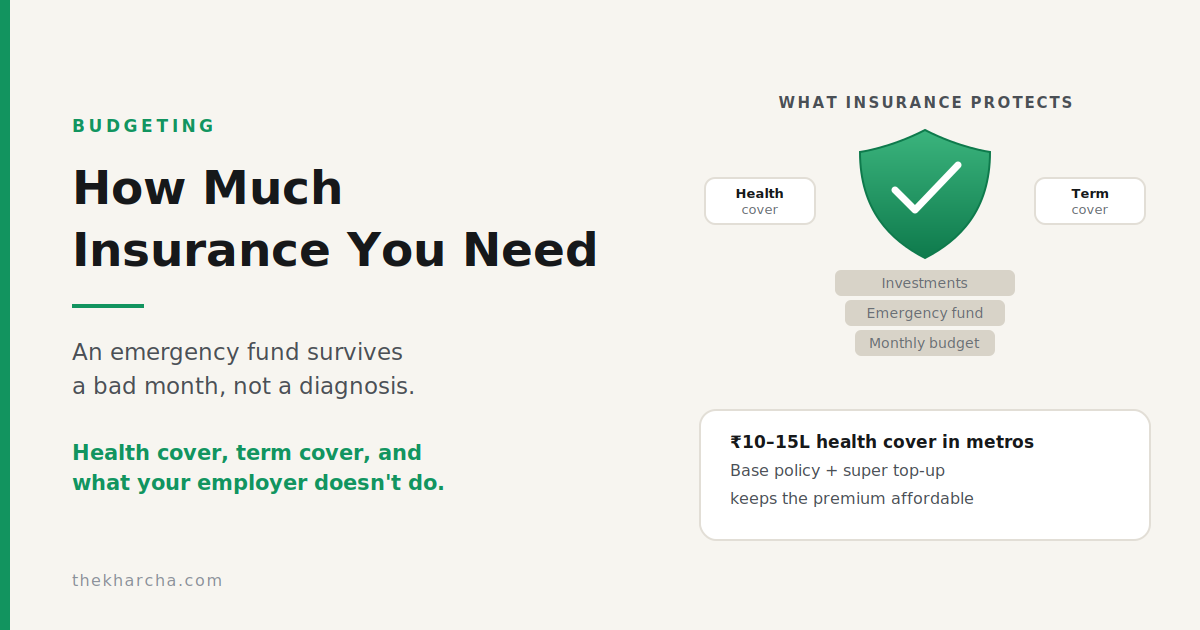
Your emergency fund is built to survive a bad month. It was never built to survive a bad diagnosis. A single serious hospitalisation in a private hospital in a major Indian city can run past ₹5–10 lakh, and a six-month emergency fund of ₹1.5–3 lakh simply was not sized for that. That is not what an emergency fund is for — it is what insurance is for, and the two get confused constantly.
Most Indian households under-insure in exactly the same way: an employer health policy that ends the day the job does, a token term plan bought because an agent was persistent, and no real calculation behind either number. Here is how to actually size both.
Health insurance: why "my employer covers it" is not a plan
An employer group health policy is real coverage, and it is worth using. It is also worth naming clearly what it is not: yours. It ends the day you resign, get let go, or the company changes providers. It is often not enough on its own for a family, and pre-existing condition waiting periods can reset if you are ever without continuous personal coverage during a job transition.
The fix is not to distrust your employer cover — it is to hold a personal health policy underneath it, so your coverage does not depend on your employment status. This is the single most common insurance gap in working India, and it is entirely avoidable with one policy bought once, held for years.
How much health cover is actually enough
The honest answer depends heavily on your city, because treatment costs vary enormously by location. As a working starting point:
- Metro cities (Mumbai, Delhi, Bangalore, and similar): ₹10–15 lakh per person as a base, more if you can comfortably afford the premium
- Tier 2 cities: ₹5–10 lakh per person as a reasonable base
- Family floater vs individual cover: a floater is usually more premium-efficient for a young, healthy family, but as parents age, a scenario where two family members are hospitalised in the same year becomes genuinely worth planning for — some households split older parents onto a separate individual policy for exactly this reason
If the premium for the "enough" number feels unaffordable right now, a super top-up policy is the standard fix, not a compromise. Keep a smaller base policy (₹3–5 lakh) and add a super top-up on top of it for a fraction of the premium a single large base policy would cost. The combination gets you to a real number without the full-size premium.
What actually breaks a claim
Two things quietly undo good intentions here. First, waiting periods — most policies exclude pre-existing conditions for two to four years, so the earlier a policy is bought, the sooner that clock finishes running, and delaying "until I actually need it" is precisely how people end up excluded when they do. Second, room rent sub-limits buried in the policy wording — a cap on daily room rent that, if breached, can proportionally reduce the entire claim, not just the room charge. Read this specific clause before buying, not after a claim is denied.
Term insurance: the cover that protects the people you provide for
Term insurance answers one question only: if you were gone tomorrow, could the people who depend on your income continue their life without a financial collapse. If nobody depends on your income — no dependent parents, no partner, no children, no loan someone else would be left holding — you may not need it yet. If anybody does, this is not optional.
It is worth separating clearly from other insurance-shaped products. A traditional endowment or ULIP mixes a small amount of insurance with a mediocre investment, and does both jobs less efficiently than doing them separately. Term insurance plus your own investing — kept as two completely separate decisions — is very often both cheaper cover and a better return than combined plans, though this is worth confirming against your own numbers rather than taken purely on faith.
How much term cover is actually enough
A common shorthand is 10–15 times annual income, but shorthand rules miss real obligations. A more accurate calculation:
- Outstanding loans that someone else would otherwise inherit — home loan, car loan, any co-signed debt
- Years of dependents' expenses you want covered — a rough number of years times annual household expenses
- Future obligations already decided, like children's education
- Minus existing savings and investments that could already cover part of this
Add the obligations, subtract what is already covered by existing assets. The result is a far more honest number than a income multiple picked without reference to what is actually owed or planned.
Buy it early, and buy it once if you can
Term insurance premiums are locked to age and health at the time of purchase. Buying at 26 versus 36 is a meaningfully different premium for the same cover, and a health condition that develops in between can make cover harder to get at any price. If dependents exist now, or are a near-certain few years away, the cheapest and simplest year to buy is this one.
The order these fit into your budget
Slotting into the sequence from a first-salary or general budgeting plan: term insurance and a personal health policy sit alongside the emergency fund, before serious investing begins — not after. The reasoning is the same in both cases: an emergency fund and investments are both vulnerable to being wiped out by exactly the event insurance exists to cover, so the protection needs to be in place before the thing it protects has much to lose.
Premiums for both are annual, predictable, and entirely a sinking-fund problem — divide the yearly premium by twelve and set aside that amount monthly, the same way a festival fund or an insurance-renewal fund would work for any other yearly expense. This is precisely how a premium that "surprises" people every renewal season stops being a surprise.
What this is not
This article is not personalised financial advice, and insurance decisions depend on family structure, health history, existing cover, and specific policy terms that vary by insurer. Read policy wording directly — particularly waiting periods, room rent limits, and claim exclusions — before buying, and treat the numbers above as a starting point for your own calculation, not a final answer.
TheKharcha helps you turn annual premiums into a monthly sinking fund, so insurance renewal season stops competing with the rest of your budget.
Comments
Loading comments…