Your First Salary: A Money Guide for Your 20s in India
"Your first paycheck feels like a lot of money — it isn't, and nobody tells you what order to do things in. Here's the sequence: split accounts, build an emergency fund, then invest, without falling into the lifestyle-inflation trap."
Admin
Expert Contributor
Your first salary lands, and for about four days it feels like more money than you have ever had in your life. It is not. It is roughly what your parents were managing an entire household on fifteen years ago, and you are about to manage it for one person — you.
Most first-salary mistakes are not stupid. They are reasonable decisions made without the one piece of information nobody hands you at 22: what order to do things in. Get the order right and the rest is arithmetic. Get it wrong and you spend your late twenties undoing your early twenties.
Here is the order.
Before you spend anything: open a second account
Most people run their entire financial life through the account their salary lands in. This is the single biggest reason first jobs fail to produce any savings — when spending money and saved money sit in the same number, spending money always wins, because the number never tells you which part is which.
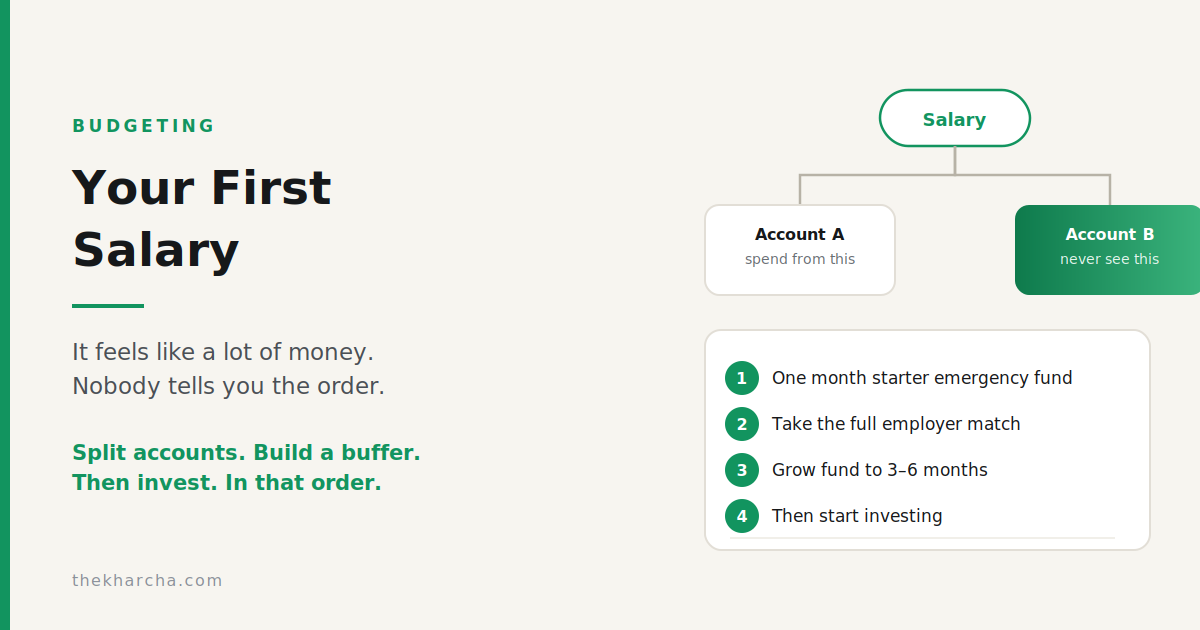
Open a second account on day one. Your salary lands in Account A. A fixed amount moves to Account B within 48 hours of every credit — before rent, before anything. Account B is not a savings account you check. It is a savings account you forget exists. That is the entire design.
The number that matters more than your salary: your fixed cost ratio
Add up rent, any EMI, and anything else you are contractually obligated to pay every month no matter what. Divide by your take-home salary.
Above 40%, you have very little room to build savings habits, and any income disruption becomes serious fast. Below 30% is comfortable. Between the two is workable but leaves little margin.
This number matters more at 22 than it ever will again, because the decisions you make right now — which city, which flat, whether you need a car immediately or in two years — set this ratio for the next several years. It is far easier to keep this ratio low from month one than to lower it after your lifestyle has grown into a higher number.
Save first, in a specific order
Not everything labelled "saving" is equally useful this early. In order:
1. A starter emergency fund — one month of expenses, fast
Before anything else, before investing, before a single SIP: one month of your actual expenses, sitting in Account B, untouched. This is not your full emergency fund — that target is usually three to six months, and that comes later. The first-month target exists purely so that a laptop repair or a sudden expense does not immediately become a credit card balance. Speed matters more than size here. Get to one month fast, even if it means everything else waits.
2. Any employer match — free money has no downside
If your employer offers a provident fund contribution or any matched benefit, take the full match before doing anything else with investing. There is no investment anywhere that reliably returns 100% instantly, and an employer match is exactly that.
3. Build the emergency fund to three to six months
Once the one-month starter fund exists, keep building toward three to six months of expenses. This step usually takes the longest, and that is fine — it is doing its job the entire time it exists, not just once it is complete.
4. Only then, start investing
Investing before an emergency fund exists means the first real emergency gets funded by selling investments at whatever price the market happens to be offering that week, or worse, by a credit card. An emergency fund is not competing with investing — it is what protects your investments from being sold at the worst possible moment.
This article will not tell you which funds or instruments to pick — that is a decision worth researching specifically, and it depends on goals and risk appetite this piece cannot know. What matters here is only the sequencing: fund first, then invest, and start the SIP as a fixed automatic transfer the same way your emergency fund contribution works — decided once, then left alone.
The lifestyle inflation trap, and how it actually works
Nobody decides to inflate their lifestyle. It happens through a series of individually reasonable upgrades that never get compared to each other as a group.
The mechanism: every raise, every bonus, every new job with a higher number quietly resets what "normal" spending feels like, almost always within about a month. The apartment gets nicer. The weekend budget grows. None of these decisions feels irresponsible in isolation — that is exactly why the pattern is so hard to notice from inside it.
The fix is not to avoid ever upgrading your lifestyle. It is to decide the upgrade on purpose, with a number, instead of letting your spending drift upward and discovering the new number a year later from your statements.
A useful rule: when income rises, split the increase before it reaches your daily spending. Roughly half toward increased saving or investing, half toward lifestyle. You still get to enjoy the raise — you just decide the split instead of your spending habits deciding it for you by default.
Credit cards: useful tool, terrible crutch
A credit card used well — building credit history, paid in full every single month, never carrying a balance — is a genuinely useful financial tool in your twenties.
A credit card used as a way to spend money you do not currently have is where a large share of debt problems in India's twenties actually start, usually from a place of reasonable optimism: "I'll have the money by the due date." Sometimes that is true. The problem is that it only has to be false once, at 36–48% annualised interest, to undo months of progress.
The rule that avoids the entire problem: only put on a credit card what you could pay in cash right now, today, from Account A. If you could not, the card is not extending your budget — it is borrowing against a future paycheque that has other jobs already.
What to actually do with the leftover
After fixed costs, after the emergency fund and investing transfers, whatever remains in Account A for the month is genuinely yours to spend without guilt. Split it loosely into a few categories — food, going out, shopping, transport — even roughly, even without an app, just so you have some sense of where it goes before the month ends rather than after.
The goal in your twenties is not maximum saving at the cost of every present enjoyment. It is a system where saving happens automatically, first, in an amount that does not require willpower every single day — so that everything left over can genuinely be spent without a small calculation running in the back of your head every time.
The one habit worth building before any other
If this article compresses into a single instruction, it is this: automate the split between Account A and Account B on day one, before your first real spending decision. Everything else in this article — the emergency fund, the investing, the lifestyle inflation discipline — is far easier to do consistently once that one habit exists, and considerably harder to build after a few years of spending from a single undivided account.
Your first salary will not feel like much in five years. What you build with it in these first months — the accounts, the automatic transfers, the habit of deciding before spending instead of after — is the part that compounds.
TheKharcha helps you set up that split from day one, with envelopes for spending and separate space for what you're building toward.
Comments
Loading comments…