The Shaadi-Diwali Quarter: How to Survive India's Most Expensive Months Without a Credit Card Bill
"Weddings, Diwali, school fees, insurance renewals — India's biggest expenses never arrive monthly, so they never show up in a monthly budget. They show up on a credit card instead. Here's how sinking funds turn ₹18,000 in March into ₹1,500 a month, and make October just October again."
Admin
Expert Contributor
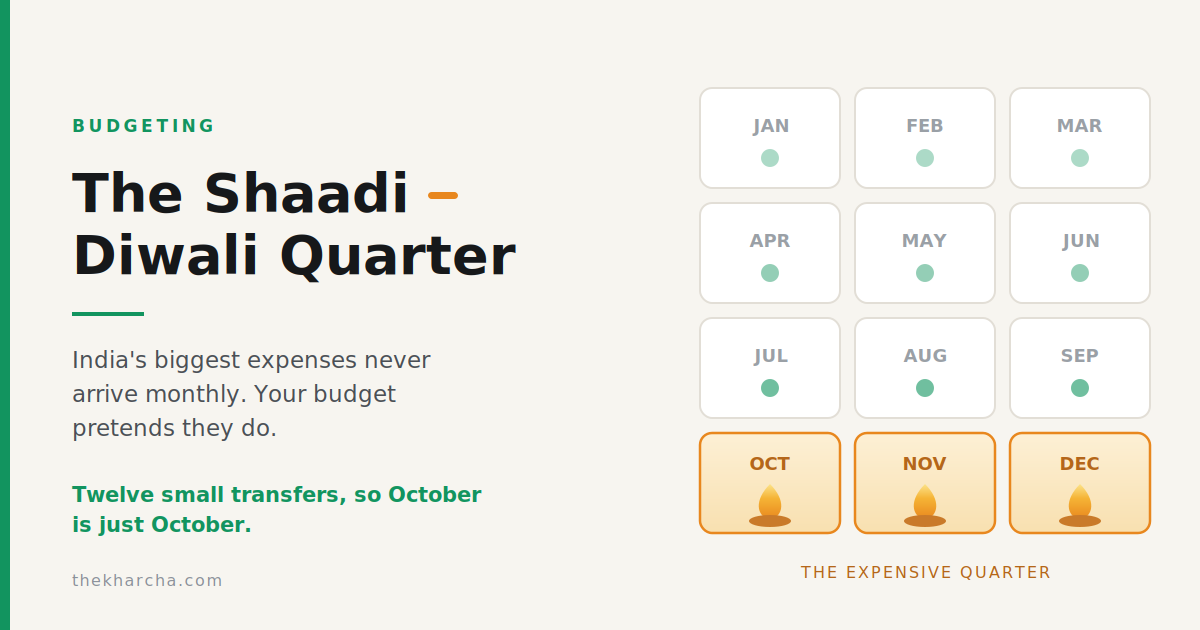
Your budget is probably fine in July.
Rent is paid, the SIP went through, groceries came in around what you expected, and the month closed without drama. You feel like you have this handled.
Then October arrives. A cousin's wedding in Jaipur — flights, a gift, an outfit you will wear once. Diwali gifts for the office, for the in-laws, for the maid and the watchman and the delivery guy who has been reliable all year. Something for the house. Sweets. Maybe a phone, because the offers are genuinely good. Then November brings the second wedding, and January brings school fees and the car insurance renewal you forgot about entirely.
By February you are paying interest on a credit card and quietly telling yourself that next year you will plan better.
You will not — not without a system. Because the problem is not that you overspend during festival season. The problem is that you budget monthly for expenses that do not arrive monthly.
The maths nobody does
Sit down once and add up everything you spend in a year that is not a monthly expense. Be honest and be complete:
- Weddings you will attend — travel, gifts, clothes, hotels
- Diwali — gifts, sweets, staff bonuses, decorations, new purchases
- School or college fees, if they come quarterly or annually
- Insurance premiums — term, health, vehicle, all of them
- Annual subscriptions and renewals
- Vehicle servicing and repairs
- Trips home, and the gifts that come with them
- One family holiday
- Medical expenses that are not covered
- Birthdays and anniversaries — yours, your partner's, your parents'
- The gadget replacement you know is coming
For a middle-class urban household in India, this list very commonly lands between ₹1.5 and ₹4 lakh a year. For many people it is 20–30% of annual income.
Now here is the uncomfortable part. That money is not optional — you will spend it, every single year. But it appears in exactly zero months of your budget. It shows up as an emergency, gets funded by a credit card or by raiding savings, and then gets forgotten until it happens again.
It is not an emergency. An emergency is unpredictable. A wedding invitation in October is about as predictable as rain in July.
Sinking funds: the boring fix that works
The solution has an unsexy name. A sinking fund is money you set aside every month for an expense you know is coming but that is not due yet.
The mechanic is simple: take the annual amount, divide by twelve, and move that much every month into a place where it waits.
Car insurance of ₹18,000 due in March is not a ₹18,000 problem. It is a ₹1,500-a-month problem — if you start early enough. That is the entire idea. You are converting lumpy expenses into monthly ones so your budget stops lying to you.
Set it up in one sitting
Step 1: Make the list and put real numbers on it
Use last year's bank and card statements — do not do this from memory, because memory always undercounts festival spending by roughly half. Go month by month from October to January of last year and add up what actually left.
Write the annual figure for each category. Round up, never down.
Step 2: Divide by 12 — or by the months you have left
Add the annual figures. Divide by 12. That is your monthly sinking-fund contribution.
If you are reading this in August and Diwali is two months away, you do not have twelve months for that one. Divide the Diwali number by two and accept that this year will be tight. Next year it will not be. Everybody's first year at this is uncomfortable — the system only pays off from year two onward, which is exactly why most people quit before it works.
Step 3: Keep it in a separate account, not in your head
This is the step people skip, and skipping it is why the system fails.
The sinking fund must live somewhere your daily UPI cannot reach. Options that work well:
- A separate savings account at a bank whose app you do not keep on your home screen, with no UPI handle linked
- A liquid or ultra-short-term debt fund, if the money is sitting for six months or more — you earn something on it and redemption takes a day, which is friction working in your favour
- Recurring deposits timed to mature just before the expense — a good fit for school fees and insurance premiums, where the date is fixed and known
What does not work: leaving it in your main account and remembering that ₹40,000 of your balance is "for Diwali." You will not remember. The balance is one number and your brain treats it as one number.
Step 4: Automate the transfer for salary day
Standing instruction, 1st or 2nd of the month, straight after salary lands. Not the 25th. Whatever survives to the 25th is never what you planned.
Step 5: Give each fund a name and a target
Track them separately even if they share an account. "Weddings 2026: ₹45,000 target, ₹22,000 saved." "Diwali: ₹35,000 target, ₹12,000 saved."
Named targets change behaviour in a way a single pooled number cannot. When you can see that the wedding fund is at ₹22,000 and the Jaipur trip will cost ₹18,000, the decision makes itself. You are not exercising willpower — you are reading a number.
The three rules that keep it alive
Do not raid the funds for regular spending. If your monthly budget is short, fix the monthly budget. Borrowing from the Diwali fund in July guarantees a credit card bill in November. You have not solved anything, only moved it.
When a fund overshoots, roll it forward. Wedding season cost less than expected? Do not treat the surplus as free money. Roll it into next year's fund or top up whichever fund is behind. Surplus that gets spent was never really surplus.
Recalculate every January. Salaries change, families grow, obligations shift. Fifteen minutes once a year keeps the numbers honest.
What changes when this works
The measurable outcome is that October stops producing a credit card balance. That alone is worth a few thousand rupees a year in interest you never pay.
But the real change is quieter. Festival season stops being a financial event and goes back to being a festival. You buy the gift without the small calculation running in the back of your head. You say yes to the Jaipur wedding without the flight price ruining the week.
Money you have already set aside spends completely differently from money you are hoping you can afford. Same rupees, entirely different feeling.
The steel dabba in your mother's almirah always had one compartment nobody touched — the one for things that had not happened yet. That was not saving. That was planning. Twelve months of small, boring transfers, so that October could just be October.
TheKharcha lets you run sinking funds alongside your monthly envelopes, so the money you set aside for Diwali stays visibly separate from the money you spend this week.
Comments
Loading comments…