How to Pay Off Credit Card Debt Fast in India: Avalanche vs Snowball
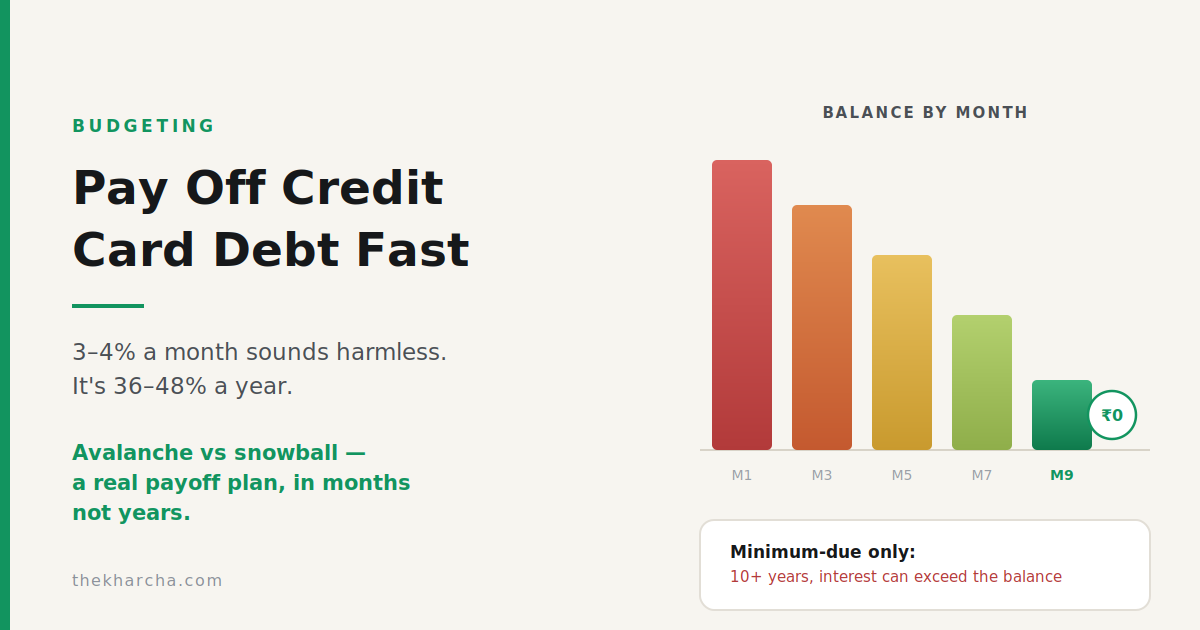
"Minimum due at 3–4% a month sounds harmless — it's 36–48% a year. Here's the avalanche and snowball methods explained with real Indian numbers, so you clear your balance in months, not years."
Admin
Expert Contributor
Every credit card in India comes with a number that sounds almost harmless: 3–4% a month. Nobody panics at 3–4%. It sounds like a bank FD, not a problem.
Multiply it out and that "harmless" number is 36–48% a year — compounding, on a balance that usually grows before it shrinks, because the minimum-due trap is built to keep it growing.
If you are carrying a balance right now, this article has one job: get you to zero, in the shortest realistic time, without pretending the process is easier than it is.
Why the minimum due is the most expensive number on your statement
The minimum due is usually 5% of your outstanding balance. Pay only that, and here is what actually happens to the other 95%: it stays on the card, accruing interest daily, and a large share of every future minimum payment goes toward interest before it touches the principal.
On a ₹1,00,000 balance at 3.5% monthly interest, paying only the minimum due can take well over ten years to clear — and the total interest paid can exceed the original balance itself. This is not a rare worst case. It is what the minimum due is designed to produce.
The single most important sentence in this article: never pay only the minimum, on any card, ever, if you have any way to pay more.
Step 1: Get the full picture in one place
List every card with three numbers: outstanding balance, interest rate (check your statement — issuers rarely advertise this clearly, but it is printed), and minimum due. Do this even if it is uncomfortable. You cannot fix what you have not fully looked at, and vague dread about "some card debt somewhere" is worse than an exact, specific number.
Step 2: Stop the bleeding before you start paying it down
Move every card you are carrying a balance on out of daily use. Not cancelled — cards you are actively paying off should generally stay open, since closing them can affect your credit history length and utilisation ratio. Just remove them from Swiggy, Amazon, and your wallet. Every new purchase on a card you are trying to pay off is a new balance at 36–48% APR, and it silently undoes the progress you are making.
If you are using one card to pay another card's bill, stop immediately and read this entire article before making another payment. That pattern does not buy time — it adds a second card's worth of interest to the first card's problem.
Step 3: Choose your payoff method — avalanche or snowball
There are two well-tested approaches, and the right one depends on you more than on the maths.
The avalanche method (mathematically optimal)
Pay minimums on every card. Put every extra rupee toward the card with the highest interest rate, regardless of balance size. Once that card hits zero, roll its entire payment — minimum plus extra — onto the card with the next-highest rate.
This method costs you the least money in total interest, provably. It is the right choice if you can stay motivated by numbers alone, even when progress feels slow at first.
The snowball method (psychologically easier)
Pay minimums on every card. Put every extra rupee toward the card with the smallest balance, regardless of interest rate. Clear it, then roll that payment onto the next-smallest balance.
This costs slightly more in total interest, but it produces a fully paid-off card faster — sometimes in the first month or two. For most people, that early win is what keeps the plan alive past month three, which is exactly when most debt payoff plans quietly die.
If you are unsure which one you are, ask honestly: have previous financial plans failed because the maths was wrong, or because you lost motivation? Choose avalanche for the first case, snowball for the second. There is no prize for choosing the "correct" one — there is only a prize for the one you actually finish.
Step 4: Find the extra rupee — the payoff engine needs fuel
Neither method works without money above the minimum to direct. Three places to find it, in order of how fast they help:
- Redirect one category, completely, for the payoff period. Not "cut back a bit everywhere" — that dissolves into nothing within two weeks. Pick eating out, or subscriptions, or shopping, and set it to zero until a specific card is cleared. One hard category cut beats five soft ones.
- Redirect windfalls entirely. Bonus, tax refund, a freelance payment that was not expected — the whole amount goes to the debt, not a portion of it. This is usually the single fastest way to knock months off a payoff timeline.
- Call the issuer about the rate. If you have a reasonable payment history, a call asking for a lower interest rate or a balance transfer to a lower-rate card sometimes works. It costs one phone call and occasionally saves real money — worth doing even if the odds feel low.
Step 5: Automate the minimums, direct the extra by hand
Set every card's minimum due on auto-pay. A single missed minimum payment triggers a late fee, a rate increase on some cards, and a hit to your credit score — a disproportionate penalty for what is often just a forgotten date, not a real financial problem.
Keep the extra payment manual. Send it deliberately, on a fixed date, to whichever card your method points to. Manual, deliberate transfers keep you looking at the balances every month, which matters — this is a plan you want to stay emotionally connected to, not one you want to forget is running in the background.
What a real payoff plan looks like
Three cards: ₹80,000 at 3.6% monthly, ₹45,000 at 3.2% monthly, ₹20,000 at 3.8% monthly. Total minimums roughly ₹7,250. An extra ₹8,000 a month is found by cutting eating-out to zero and redirecting a festival bonus.
Avalanche order: the ₹20,000 card first (highest rate), then the ₹80,000 card, then the ₹45,000 card. At this pace, the full ₹1,45,000 clears in nine to eleven months, depending on exactly how consistently the extra payment is made — versus several years, and roughly double the total interest, on minimums alone.
The number that matters is not the total balance. It is the number of months, because months are the thing you can actually plan around and stay motivated toward.
After the last card hits zero
The single biggest risk after paying off credit card debt is not a new debt — it is treating the freed-up "extra payment" amount as spending money the moment the last card clears. Redirect it immediately, in this order: first into an emergency fund if you do not have one, then into the sinking funds for the expenses that likely caused the debt in the first place — festival season, a wedding, an annual premium.
The habit that got you to zero — a fixed amount leaving your account every month, on purpose, before you can spend it elsewhere — is the same habit that keeps you there. Only the destination changes, from a card balance to a fund with your name on it.
TheKharcha helps you run a payoff plan and your monthly envelopes side by side, so paying down debt does not mean losing track of everything else.
Comments
Loading comments…