How to Build Your First ₹50,000 Emergency Fund — Even on a Low Salary
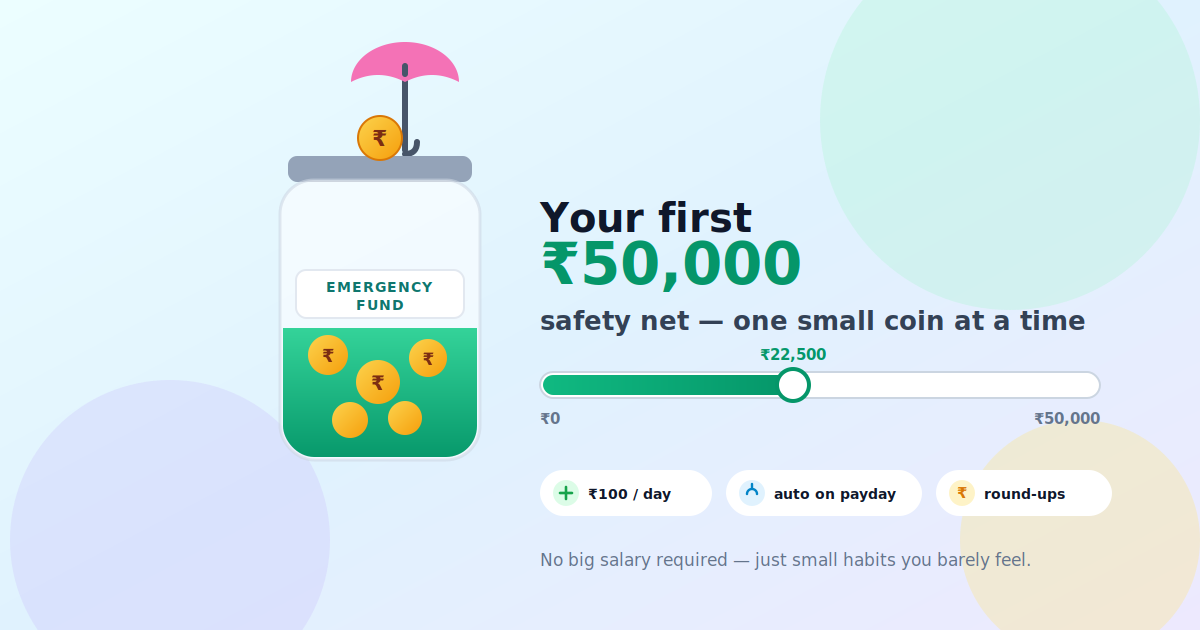
"You don't need a big salary to build an emergency fund. You need a system small enough that you barely feel it."
Admin
Expert Contributor
Be honest: if your bike broke down tomorrow, or your phone died, or you had to rush home for a family emergency and book a last-minute ticket — where would the money come from?
For a lot of people, the answer is a credit card, a loan app, or an awkward message to a friend. Not because they're careless, but because there's simply no cushion. Every rupee that comes in already has a name on it before the month ends.
That's exactly what an emergency fund fixes. And here's the part nobody tells you: you don't need a big salary to build one. You need a system small enough that you barely feel it.
This is a step-by-step plan to save your first ₹50,000 — even if money feels tight right now. No jargon, no "just invest in stocks," no guilt. Just a target, a few tiny habits, and a way to protect the money once it's there.
Why ₹50,000, and Why It Comes Before Investing
An emergency fund is money set aside for one job only: to catch you when life throws something unexpected and expensive. A medical bill. A job gap. An urgent repair. A family crisis.
Why ₹50,000 as a first goal? Because it's big enough to actually cover most real emergencies — and small enough to feel reachable. It's a starter fund. Later you can grow it toward the classic target of 3–6 months of expenses, but ₹50,000 is the milestone that changes how you feel about money. The first time you handle an emergency without panicking or borrowing, something shifts.
And it has to come before investing. People often rush into mutual funds or stocks while having zero buffer. Then an emergency hits, the market happens to be down, and they're forced to sell at a loss or fall into debt anyway. An emergency fund is the foundation the rest of your money life is built on. Boring, but unshakeable.
The mindset shift: An emergency fund isn't money you're "losing" to a savings account. It's money buying you something valuable — the ability to say "I've got this" instead of "how will I manage?"
Step 1: Turn ₹50,000 Into a Daily Number
A big lump sum feels impossible. A small daily number feels doable. So the first move is to break the goal down until it stops scaring you.
Here's the same ₹50,000 goal at different paces:
| You save…Per monthYou hit ₹50,000 in… | ||
| ₹50 / day | ~₹1,500 | about 33 months |
| ₹100 / day | ~₹3,000 | about 17 months |
| ₹167 / day | ~₹5,000 | 10 months |
| ₹275 / day | ~₹8,000 | about 6 months |
Notice: even at the slowest pace — the price of a couple of teas a day — you get there. The point isn't to pick the fastest pace. It's to pick the pace you can actually keep up without quitting. A small amount you sustain for two years beats a big amount you abandon in three weeks.
Pick your number now. Write it down. That's your target.
Step 2: Pay Yourself First (Before the Money Disappears)
Most people try to save what's left at the end of the month. There's never anything left. That's not a discipline problem — it's an order-of-operations problem.
Flip it. The day your salary arrives, move your savings amount out first, before bills, before spending, before it has a chance to evaporate. Treat it like a non-negotiable bill called "Future Me."
The most reliable way to do this is to automate it: set a standing instruction or auto-transfer that moves your chosen amount to a separate account on salary day. When saving happens automatically, willpower stops being the bottleneck. You can't spend what you never saw.
If your income is irregular — freelancing, daily wages, commissions — automate a smaller fixed amount you can always manage, and top it up by hand on the good months.
Step 3: Stack Up Micro-Saving Habits
Automation builds the base. Micro-habits accelerate it. None of these require more income — just a little attention. Use the ones that fit your life:
- The round-up rule. Mentally round every spend up to the next ₹10 or ₹100 and stash the difference. A ₹74 spend? Move ₹26 to savings. Tiny amounts, surprisingly fast totals.
- The note rule. Decide that every ₹50 (or ₹100) note that lands in your hand goes straight into a tin you don't open. A simple, almost game-like habit if you handle cash.
- No-spend days. Pick two days a week where you spend nothing beyond essentials. Move what you would have spent into the fund.
- Save the windfalls. Bonus, festival gift, tax refund, cashback, money returned by a friend — send at least half of any unexpected money straight to the fund before it feels like "spending money."
- The "skip one" swap. One fewer food delivery a week, one fewer impulse buy. Don't cut everything — cut one thing, and save what it would have cost.
You don't need all of these. Pick two that feel easy and let them run on autopilot.
Step 4: Keep the Money Where You Can't Casually Touch It
This step quietly decides whether you succeed. If your emergency fund sits in the same account you spend from, you will spend it — not on purpose, just by erosion.
So separate it. The rule of thumb for an emergency fund is safe and reachable, not high-return. You're not trying to grow this money; you're trying to be able to grab it fast when you need it, without losing any of it.
Common places people park a starter fund — pick whatever creates the right amount of friction for you:
- A separate savings account you don't link to your UPI apps, so it's out of sight and one step removed from impulse.
- A recurring deposit (RD), which also forces a fixed monthly contribution — helpful if you need the discipline.
- A liquid or overnight fund, which keeps the money accessible within a day or two.
(This is general information, not personalised financial advice — the right choice depends on your bank, your comfort, and how quickly you'd need the cash. When in doubt, accessibility wins over returns for an emergency fund.)
The goal is simple: easy enough to reach in a real emergency, annoying enough that you won't raid it for a sale.
Step 5: Create an "Emergency Fund" Envelope
Even before the money lives in a separate account, it helps to give it a name and a home in whatever you use to track money. This is the old envelope-budgeting idea, updated: instead of a physical envelope of cash, you create a dedicated "Emergency Fund" bucket and watch it fill.
Why this works so well:
- It makes the goal visible. A number climbing toward ₹50,000 is motivating in a way that "money somewhere in my account" never is.
- It separates this money in your mind. Once it's labelled "Emergency Fund," spending it feels like breaking a promise — which is exactly the friction you want.
- It turns saving into a game. Each contribution nudges the bar up. Hitting ₹10,000, then ₹25,000, then ₹50,000 gives you milestones to celebrate.
In a simple expense-tracker app, setting this up takes a minute: create a category or goal called "Emergency Fund," set the target to ₹50,000, and log every contribution to it. Suddenly the abstract goal has a progress bar — and progress bars are weirdly powerful for keeping you going.
The One Rule That Protects the Fund: Define "Emergency"
A fund only works if you don't drain it for things that aren't emergencies. The hard part isn't saving — it's not spending. So set the rule in advance, while you're calm, not in the heat of wanting something.
A real emergency is usually: a medical need, sudden loss of income, an urgent and unavoidable repair (home, vehicle, phone you need for work), or a genuine family crisis. The test: is it urgent, necessary, and unexpected? If it's not all three, it's probably not an emergency.
Not an emergency: a festival sale, a trip, a new gadget, a wedding gift you knew was coming, an upgrade you simply want. Those deserve their own savings goals — separate from the fund that keeps you safe.
If you do dip in for a true emergency, that's the fund doing its job — no guilt. Just make refilling it your next priority.
Stay Motivated: Celebrate the Milestones
Saving is a long game, and motivation fades. Build in small wins so you don't quit at month three:
- Mark every ₹10,000. Acknowledge it. You earned it.
- Track the streak. Months of consistent saving become a streak you won't want to break.
- Picture the relief. Imagine the next unexpected bill landing — and you simply handling it. That feeling is what you're buying.
Common Mistakes to Avoid
- Waiting for a "better month." It never comes. Start with ₹50 a day today rather than ₹5,000 a month "later."
- Setting the bar too high. An aggressive target you can't sustain leads to quitting. Start small and raise it once the habit sticks.
- Keeping it too accessible. If it's one tap away in your spending app, it's already half-spent. Add friction.
- Investing it for returns. An emergency fund's job is safety and speed, not growth. Don't put your only buffer into something volatile.
- Not refilling after using it. Once you dip in, topping it back up becomes the new priority — treat it like repaying a loan to yourself.
Frequently Asked Questions
How much should my first emergency fund be? ₹50,000 is a strong first target — enough to cover most common emergencies and reachable for most people. Once you hit it, aim toward 3–6 months of essential expenses as your next goal.
How can I save on a low salary when nothing is left over? Save first, not last. Automate a small amount on salary day before you spend, and break the goal into a tiny daily number (even ₹50/day works). The size matters far less than the consistency.
Where should I keep my emergency fund? Somewhere safe and quick to access — a separate savings account, a recurring deposit, or a liquid fund are common choices. The priority is accessibility and safety, not high returns. (General info, not personalised advice.)
How long will it take to save ₹50,000? Depends on your pace: roughly 10 months at ₹5,000/month, about 17 months at ₹3,000/month, and around 33 months at ₹1,500/month. Pick the pace you can sustain.
Should I build an emergency fund or pay off debt first? A common approach is to build a small starter buffer first (so a new emergency doesn't push you deeper into debt), then attack high-interest debt aggressively, then grow the fund further. Your situation may vary.
What counts as a real emergency? Something urgent, necessary, and unexpected — a medical bill, income loss, an unavoidable repair, a family crisis. Sales, trips, and gadgets don't qualify; give those their own savings goals.
Start With ₹50 Today
You don't need a raise to build an emergency fund. You need a target you've broken into a daily number, savings that move automatically before you can spend them, a couple of small habits, and a separate place where the money is safe but not tempting.
The first ₹50,000 is the one that changes everything — the moment money stops being a source of quiet dread and becomes something you actually have a handle on. And the only way to get there is to start small, today, and let consistency do the heavy lifting.
If it helps to see the fund grow, keep a dedicated "Emergency Fund" goal in whatever you use to track your money. TheKharcha lets you set up that envelope and watch the bar climb toward ₹50,000 — a small nudge that makes the habit a lot easier to keep.
The best day to start was your last payday. The next best day is the next one.
Comments
Loading comments…